Curriculum Vitae - Phillip H.
Larson
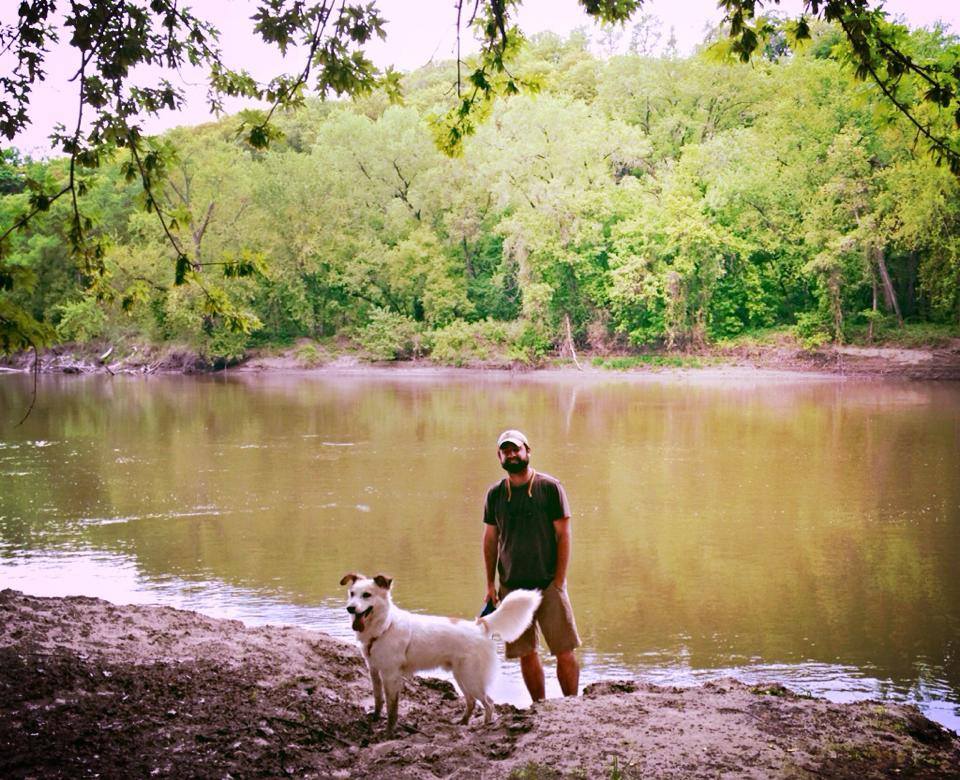
(Zion
(the dog) at the Minnesota River; See: Larson,
P.H., Dorn, R.I., Faulkner, D.J, Friend,
D.A. (2015). Toe-Cut Terraces: A Review and Criteria to
Differentiate from Traditional Fluvial Terraces.
Progress in Physical Geography. DOI:
10.1177/0309133315582045)
Curriculum
Vitae - Phillip H.
Larson
Phillip
H. Larson, Professor
Co-Director,
AGES/EARTH
Systems Laboratory
Minnesota
State University, Mankato
Graduate
Faculty/Adjunct Faculty
University
of Minnesota, Earth and Environmental Sciences
Email:
phillip.larson@mnsu.edu
Office:
5073892617
Website
(Personal): https://www.philliphlarson.com
Website
(Research Group): https://mnimorph.science/
BRIEF BIO:
I was born in Red Wing,
Minnesota, and was raised along the banks of the upper
Mississippi and St. Croix Rivers. The geography of
my upbringing resulted in a life-long interest in the
physical landscapes around me. This interest in our
planet and the landscapes around us was supercharged
during my childhood as a result of family vacations to
the canyons and incredible landscapes of the southwest
United States, high alpine landscapes of the Rocky
Mountains, and the beautiful juxtaposition of mountains,
volcanism, and coasts in the northwest United
States. Locations like Zion, Olympic, Mt. Rainier,
Grand Canyon, Canyonlands, Arches, and others,
instilled a deep appreciation and passion for these
places. Meanwhile, at home, I spent a large part of my
childhood observing and wondering about the landscapes
in the upper Midwest and enjoying the serenity and
beauty within them. Despite these experiences, I grew up
in a small town and had little understanding of science
or what careers exist within understanding our
environment. Upon graduating high school, like most in
my family before me, I worked in a factory (building
cast iron fire hydrants and valves). Creating things
with my hands and working my tail off on the assembly
line was, indeed, rewarding. But, I often found myself
desiring for something “more.” I decided to go
back to school as a first-generation student to see what
other opportunities were out there.
When I entered my undergraduate degree pursuits, first
at the University of Wisconsin-Stevens Point and
finishing at the University of Wisconsin-Eau Claire, I
initially found myself overwhelmed and confused about
how to determine a path in life. Thankfully, I
took introductory courses in Physical Geography and
Physical Geology and was encouraged by inspiring
professors that I, too, could be a geoscientist. It,
quite literally, blew my mind! And, suddenly, the
childhood passion for the landscapes and natural world
around me was rekindled, and it turned into a life-long
pursuit of learning, educating, and scientific research
in the geosciences. I continued these academic pursuits
into graduate work (both Master’s and Ph.D.) at Arizona
State - which was an incredible experience.
Today, I consider myself so incredibly fortunate to be
geoscientist - with profound and passionate interest in
using geomorphic systems to: 1) address fundamental
questions about earth surface processes, 2) understand
the impact climatic change (both past and present) has
on these systems, 3) understanding how environmental and
climatic variability impacts humanity in the present and
in the past (geoarcheology!), and 4) understand
anthropogenic activities and natural hazards impact
communities and the environment. I previously served as
the Director of Earth Science Programs (merged with
Geospatial Sciences to become Earth and Geospatial
Sciences Program in 2025), founded the AGES/EARTH
Systems Laboratory, and continue in my duties as
Professor in the Department of Anthropology and
Geography at Minnesota State, where I have taught
nearly thousands (~5,000 as of 2025) of students.
I am also Graduate Faculty in the Department of Earth
and Environmental Sciences at the University of
Minnesota-Twin Cities where I work closely with faculty
there and have worked with Dr. Andrew Wickert to found
our merged faculty-student research group – MNiMORPH (click
here
to learn more).
RESEARCH AND
TEACHING SYNOPSIS:
Summary of research interests:
Utilizing geomorphic systems and
earth surface processes to understand
climate/environment change (both past and
present), fluvial system and drainage basin
evolution, erosional (primarily fluvial processes) and
hillslope processes and hazards (e.g. landslides, debris
flows, rock falls, etc.), river/watershed science and
water resources, and human-environment interactions
(both past and present - have begun branching into
geoarcheology and stream restoration).
Skills/Methods utilized in research: I am
primarily a field-based and experimental geoscientist. I
typically compile field-collected data and incorporate
remotely sensed data to address scientific questions
and/or problems impacting humanity per the research
interests outlined above. I often utilize field
mapping/surveying, global navigation satellite systems,
ground penetrating radar, geochronologic methods (e.g.
optical stimulated luminescence, cosmogenic
radionuclides), sedimentologic and surficial geologic
observations and measurements (coring, mapping,
description, interpretation, geochemical fingerprinting,
particle size analysis), and geographic information
systems to compile field data with remotely sensed data
sets (e.g. LiDAR, satellite imagery). I am currently
working on professional growth into a new approach (for
me) to address questions/problems through implementation
of physical experiments/physical models in the
laboratory. I hope that this will become a significant
component of future research and teaching endeavors.
My research and
teaching interests are intertwined. At the most
fundamental level, I am guided by the philosophy of
being a “Teaching Scholar.” In the simplest
sense, this philosophy drives an approach of integrated
teaching, research, and student mentorship.
Integration begins through learner-centered, applied,
and experiential learning in teaching and mentorship,
both in direct-contact and virtual classrooms. I achieve
the learner-centered, applied, and experiential approach
by integrating my research, both theoretical and
applied, with classroom pedagogy and by supplementing
this with development of extracurricular mentoring and
research experiences with the students. In other
words, my research is my teaching and vice versa - they
are a "fused" endeavor. Students I work with, at
any level in their education, are engaged in real
problems, real questions, and real science - often
funded externally through state or federal-level
grants/contracts. They learn not only what we
know, as is traditionally pursued in the classroom via
lecture and/or a textbook, but they also learn how the
scientific process unfolds and obtain methodological
expertise through conducting the science themselves
under my guidance. In this way, I stay current,
while addressing important questions in my field. And,
often, this work serves the community by helping those
impacted by or impacting the natural world around them.
Importantly, through this, my students obtain a unique
and highly impactful experience that allows them to stay
at a competitive advantage in the workforce or to
progress further in academia when they graduate.
PROFESSIONAL POSITIONS:
Professor:
Minnesota State University, Mankato, MN. 2021-Present
Graduate Faculty:
University
of Minnesota, Earth and Environmental Sciences.
2019-Present
Graduate Program Coordinator -
M.S. Geography:
Minnesota State University, Mankato, MN. 2019-2021; 2024
Associate Professor:
Minnesota State University, Mankato, MN. 2018-2021
Assistant Professor:
Minnesota State University, Mankato, MN. 2013-2018
Director of Earth Science Programs:
Minnesota State University, Mankato, MN. 2014-2025
(Program was merged into Earth and Geospatial Sciences
in 2025)
Founder and Co-Director, AGES Laboratory/EARTH
Systems Laboratory
Minnesota State University, Mankato, MN.
2016-2021.
Full Course Instructor:
School of Geographical Science and Urban Planning –
Arizona State University, Tempe, AZ. 2010-2013
Taught Geography 101 (Intro Physical Geography),
Geography 211 (Landform Processes)
Lead Graduate Teaching Assistant:
School of Geographical Sciences and Urban Planning -
Arizona State University, Tempe, AZ. 2009-2013.
EDUCATION:
Doctor of Philosophy (Ph.D.)
in Geography, August 2013.
Arizona State University, School of Geographical
Sciences and Urban Planning, Tempe, AZ
Dissertation: “Desert
fluvial terraces and their relationship with basin
development in the Sonoran Desert, Basin and Range:
Case studies from south-central Arizona.”
Master of Arts (M.A.) in
Geography, May 2011
Arizona State University, School of Geographical
Sciences and Urban Planning, Tempe, AZ
Research Exam (Anthony J. Brazel
Award Winner 2010-2011)
Bailey Research Scholarship (2010)
Master's Research: "Landform development in the South Mountains
Metamorphic Core Complex."
Bachelor of Science (B.S.) May 2008
University of Wisconsin - Eau
Claire
Major 1: Geography-Resource
Management
Major 2: Geology
Undergraduate Research: Genesis of cliff-top
dunes; Terraces of the Chippewa River valley
JOURNAL PUBLICATIONS:
* denotes graduate student authors, authors in italics indicate
undergraduate
authors. TBS = to be submitted (author orders are
placeholders)
In Preparation or In Review
- Wickert, A.D., Jones, J.C., Libby, D., Larson, P.H., Barnhart, K.R., Van Wyk de Vries, M.S., Schildgen, T.F. (In Review, 2026). Alluvial river-channel width: transient adjustment and dynamic equilibrium. Earth Surface Dynamics
- *Penprase, S.B., Wilwerding, A.C., McKenzie, M., Wickert, A.D., Larson, P.H., Rittenour, T.M. (In Review, 2025). Slackwater sediments reveal time-variable glacial meltwater routing down the Upper Mississippi River at the Younger Dryas-Holocene transition. Boreas.
- Larson, P.H., *Fischer, A., Breckenridge, A., Wickert, A.D. *Romero, M., Seong, Y.B. (in prep, Fall 2026). Final eastward routing and origin of megaflood-scale bedforms of the Lake Superior basin: Christmas Dunes, MI, USA. Geology.
- Larson, P.H.,
Millett, J.*, Running, G.L., Faulkner, D.J.,
Rittenour, T., Burds, L.*, Schirmer, R., Schaetzl,
R. (in prep, TBS Spring 2027). The origin,
geomorphology, and paleoenvironmental significance
of cliff-top dunes in the upper Mississippi River
basin: A review and case study from the Chippewa
River valley, Wisconsin, USA. Earth Science
Reviews.
- Laaksonen, M., Larson,
P.H., Wickert, A.D., Breckenridge, A.,
Rittenour, T., Seong, Y.B. (in prep, TBS Spring 2027).
Western Meltwater Floods of the Lake Superior Basin
and Geomorphology of the Brule Spillway, Northwestern
WI, USA. Geological Society of America Bulletin.
- Larson, P.H., Dorn, R.I., Atkins, R., Douglass, J.C., Faulkner, D.J., X Rittenour, T.M., Seong, Y.B., Jeong, A. (in prep, TBS Summer 2027). Aggradational piracy as an underappreciated process of drainage integration and landscape evolution. Earth Surface Processes and Landforms
- Rowen, J., Larson,
P.H., Romero, M., Seong, Y.B. (in prep,
TBS Fall 2027). Geomorphology, Chronology, and
Character of Megaflood Bedforms of Glacial Lake
Missoula, Camas Prairie, Montana, USA. Nature
Geoscience.
Published
NOTE: 2023-2024: This gap is the
result of post viral and bacteria illness and
recovery (Lyme disease and COVID19 complications).
Work continued on grants, with students, and with
conference presentations (as seen elsewhere in the
C.V.), but mental and physical capacity was severely
limited during this time. Please ask if you have
questions
- *Wood, J., Wickert, A.D., Larson, P.H., Svien, L. (2026). A 140-year record fo stream and valley sedimentation in the Whitewater River Valley, Minnesota, United States. Scientific Data. https://www.nature.com/articles/s41597-026-07866-0
- *Penprase, S., Wickert, A., Larson, P.H., *Wood, J., Larsen, I., Rittenour, T. (2025). Plow vs. ice age: Erosion rate variability from glacial-interglacial climate change is an order of magnitude lower than agricultural erosion in the upper Mississippi River Valley. Geology.
- https://pubs.geoscienceworld.org/gsa/geology/article/doi/10.1130/G52585.1/653452/Plow-versus-Ice-Age-Erosion-rate-variability-from
- Triplett, L., Hammer, M.N., Delong, S.B., Gran, K.B., Jennings, C.E., Engle, Z.T., Bartley, J.K., Blumentritt, D.J., Breckenridge, A.J., Day, S., *Kohout, M.A., Larson, P.H., Mcdermott, J.A., Richard, E.M. (2025). Landslide occurrence and susceptibility dictated by glacial activity and post-glacial fluvial network development in Minnesota, USA. Natural Hazards. https://link.springer.com/article/10.1007/s11069-025-07262-8
- *Shandonay, K.L., Bowen, M.W., Larson, P.H., Running, G.L., Rittenour, T., *Mataitis, R. (2022). Morphology and stratigraphy of aeolian sand stringers in southeast Minnesota and western Wisconsin, USA. Earth Surface Processes and Landforms. https://doi.org/10.1002/esp.5428
- Larson, P.H., Dorn, R.I., Skotnicki, S., Seong, Y.B. Gootee, B. (2022). Drainage integration in extensional tectonic settings and the revival of the great rivers of Arizona. Geomorphology. https://doi.org/10.1016/j.geomorph.2021.108082
- Schaetzl, R., Running, G., Larson, P.H., Rittennour, T., Yansa, C., Faulkner, D. (2021). Luminescence dating of sand wedges constrains the late Wisconsin permafrost interval in the upper midwest, USA. Boreas. https://doi.org/10.1111/bor.12550
- Larson, P.H., Dorn, R.I., Skotnicki, S., Seong, Y.B., DePonty, J. (2020). Impact of drainage integration on basin geomorphology and landform evolution: Case study along the Salt and Verde Rivers of the Sonoran Desert, USA. Geomorphology. https://doi.org/10.1016/j.geomorph.2020.107439
- Skotnicki, S., Seong, Y.B., Dorn, R.I., Larson, P.H., Deponty, J. (2020). Drainage integration of the Salt and Verde Rivers in a Basin and Range extensional landscape, central Arizona, USA. Geomorphology.https://doi.org/10.1016/j.geomorph.2020.107512
- *Hilgendorf, Z, *Wells, G., Larson, P.H., *Millett, J., *Swanson, M. (2020). From basins to rivers: Understanding the revitalization and significance of top-down drainage integration mechanisms in drainage basin evolution. Geomorphology. https://doi.org/10.1016/j.geomorph.2019.107020
- Dorn, R., Larson, P.H. (2019). Forward: Episodic forward prolongation of trunk channels in the Western United States. Geomorphology, 343. https://doi.org/10.1016/j.geomorph.2019.06.010
- Oh, J.S., Seong, Y.B., Larson, P.H., Hong, S.C., Yu, B.Y. (2019). Asymmetric hillslope retreat on Rock Peak, San Tan Mountains, Arizona, USA: Assessing caprock lithology control on landscape evolution. Annals of the American Association of Geographers. https://doi.org/10.1080/24694452.2019.1624421
- Donovan, M., Belmont, P., Notebaert, B., Coombs, T., Larson, P.H., Souffront, M. (2019). Accounting for uncertainty in measurements of river channel migration. Earth Science Reviews. https://doi.org/10.1016/j.earscirev.2019.04.009
- Schaetzl, R., Larson, P.H., Faulkner, D.J., Running, G.L., Jol, H.M., and Rittenour T. (2018). Eolian sand and loess deposits indicate west-northwest paleowinds during the Late Pleistocene in western Wisconsin, USA. Quaternary Research. 89: 769-785. https://doi.org/10.1017/qua.2017.88
- Yuan, F., Larson, P.H., Mulvihill, R., *Libby, D., Nelson, J., Grupa, T., Moore, R. (2017). Mapping and Analyzing Stream Network Changes in Watonwan River Watershed, Minnesota, USA. International Journal of Geo-Information. https://doi.org/10.3390/ijgi6110369
- Larson, P.H., Meek, N., Dorn, R.I., Douglass, J., Seong, Y.B., (2016). How Rivers Get Across Mountains: Transverse Drainages. Annals of the American Association of Geographers. https://doi.org/10.1080/24694452.2016.1203283
- Larson, P.H., Kelley, S., Dorn, R.I., Seong Y.B. (2016). Pace of Landscape Change in the northeastern Sonoran Desert, United States. Annals of the American Association of Geographers. https://doi.org/10.1080/24694452.2016.1201420
- GK GILBERT AWARD RECIPIENT – American Association of Geographers Geomorphology Specialty Group: Faulkner, D., Larson, P.H., Jol, H.M., Running, G.L., Loope, H.M., and Goble, R.J. (2016). Episodic Incision and Terrace Formation Resulting from Abrupt Late-Glacial Base-Level Fall, Lower Chippewa River, Wisconsin, USA. Geomorphology. 266: 75-95. https://doi.org/10.1016/j.geomorph.2016.04.016
- Seong, Y.B., Larson, P.H., Dorn, R.I. and Yu, B.Y. (2016). Evaluating process domains in small arid granitic watersheds: Case study of Pima Wash, South Mountains, Sonoran Desert, USA. Geomorphology. 255: 108-124. https://doi.org/10.1016/j.geomorph.2015.12.014
- Larson, P.H., Dorn, R.I., Faulkner, D.J, Friend, D.A. (2015). Toe-Cut Terraces: A Review and Criteria to Differentiate from Traditional Fluvial Terraces. Progress in Physical Geography. https://doi.org/10.1177/0309133315582045
- Larson, P.H. and Dorn, R.I. (2014). Strath Development in Small Arid Watersheds: Case Study of South Mountain, Sonoran Desert, Arizona. American Journal of Science. 314: 1202-1223. https://doi.org/10.2475/08.2014.02
- Larson, P.H., Dorn, R.I., *Palmer, R.E., *Bowles, Z., *Harrison. E., *Kelley S., Schmeeckle, M. W., Douglass, J. (2014). Pediment Response to Drainage Basin Evolution in South-Central Arizona. Physical Geography. https://doi.org/10.1080/02723646.2014.931089
- Dorn, R.I., Dorn, J., *Harrison, E., *Gutbrod, E., Gibson, S., Larson, P.H., Cerveny, N., Lopat., N., Groom, K.M., Allen, C.D. (2012). Case Hardening Vignettes from the Western USA: Convergence of Form from a Divergence of Hardening Processes. Association of Pacific Coast Geographers Yearbook. 74: 112.
- Larson, P.H. and Dorn, R.I. (2012). Painting Yosemite Valley: A Case Study From the Rock Coatings Encountered at Half Dome. Physical Geography 33: 165-182. https://doi.org/10.2747/0272-3646.33.2.165
- Larson, P.H., Dorn, R.I, Douglass, J., Gootee, B.F., Arrowsmith, R. (2010). Stewart Mountain Terrace: A New Salt River Terrace with Implications for Landscape Evolution of the Lower Salt River Valley, Arizona. Journal of the Arizona-Nevada Academy of Science 42: 26-35. https://doi.org/10.2181/036.042.0105
PUBLISHED
DATA INVENTORIES, REPORTS
* denotes graduate student
authors, authors in italics indicate undergraduate
authors.
- England, H.O., Brown,
A.B., Larson, P.H., Hilgendorf, Z.T.,
*Rowen, J.K. (2025). Whitewater River Planform Change
Analysis. University Digital Conservancy: Data
Repository for the University of Minnesota (DRUM).
Product of the Legislative-Citizen Commission on
Minnesota Resources - Environment and Natural
Resources Trust Fund project entitled: "Land-use
and climate impacts on Minnesota's Whitewater River"
- DeLong, S.B., Engle, Z.T.,
Hammer, M.N., Jennings, C.E., Gran, K.B., Bartley,
J.K., Blumentritt, D.J., Breckenridge, A.J., Day,
S., Larson, P.H., McDermott, J.A.,
Triplett, L.D., Wickert, A.D., Richard, Emilie, M., *Swanson,
M.A., Allison, M., Dahlseid, A., Dahly, D.T.,
Dean, B.A., Endres, M., Kurak, E., Link, S., Matti,
B., Rehwinkel, R.W., Sockness, B., VanBerkel, J.,
Willard, J.G., and Williams, A.B., (2021). Inventory
of landslides in the northwestern, northeastern,
southern, and southeastern parts of Minnesota: United
States Geological Survey data release. https://doi.org/10.5066/P94KF6OM
- Larson, P.H., Belmont, P., Water Resources Center. (2018). Final Report - Minnesota River Invasive Carp Prevention Workplan: Minnesota DNR. Lessard-Sams Outdoor Heritage Council through Minnesota DNR - Minnesota River Invasive Carp Workplan.
- https://geo.mnsu.edu/geo/DNR-InvasiveCarp/FinalReport-InvasiveCarpWorkplanFinal.docx (username: landforms ; password: rock)
BOOKS, BOOK CHAPTERS,
EDITOR/SPECIAL ISSUES:
* denotes graduate student authors, authors in italics indicate
undergraduate
authors
- Larson, P.H., Ritter, M. (current) “The Physical
Environment.” 4th edition. Online digital textbook for
introduction to Physical Geography and Earth
Science. Utilized by introductory students
at Minnesota State and Arizona State.
- Dorn, R.I., Larson,
P.H., Jeong, A. (2025). “Landforms on
Faulted Rocks” in Essentials of
Geomorphology. Cambridge University Press.
Schaetzl, R., Marston, D., Eds. https://www.cambridge.org/highereducation/books/essentials-of-geomorphology/C043BE51FDD9AED47FED30A5EA6EFDCB#overview
- Larson, P.H., Dorn, R.I., Seong, Y.B., Gootee, B.
(2022). Special Issue: "Drainage Integration in
Extensional Tectonic Terrains." Geomorphology. https://www.sciencedirect.com/journal/geomorphology/special-issue/10769TKL6KQ
- Hargitai, H. and Larson,
P.H. (2015). "Valley Terrace" in The
Encyclopedia of Planetary Landforms. Springer. https://doi.org/10.1007/978-1-4614-9213-9_629-1
- Larson, P.H. and
Dorn, R.I. (2015). "Radiometric
dating/techniques" in The
International Encyclopedia or Geography: People, the
Earth, Environment and Technology. Wiley
Blackwell. https://doi.org/10.1002/9781118786352.wbieg0077
- Larson, P.H., *Harrison,
E.J., and *Palmer, E. (2013). "Introductory Physical
Geography Laboratory Manual", 10th edition, Hayden
McNeil: Michigan.
- Larson, P.H. (2012).
"Introductory Physical Geography Laboratory Manual",
9th edition, Hayden McNeil:
Michigan.
NON-REFEREED PUBLICATIONS,
REPORTS, and/or PUBLISHED ABSTRACTS:
* denotes graduate student authors, authors in
non-bold italics indicate undergraduate
authors
- Atkins, R.M., Kleber, E.J., Reeher, L.J., Morriss, M.C., Rittenour, T.M., Larson, P.H. (2026). Drainage Reorganization in the Kamas Valley: Aggradational Piracy of the Ancestral Provo River, Utah. Geological Society of America annual meeting. https://gsameetings.secure-platform.com/connects26/gallery/rounds/82026/details/27385
- *Gould, E., Hilgendorf, Z., Olson, L., Larson, P.H., Ellefson, M., Lore, J., Brown, A., Rowen, J. (2026). The Avulsive Failure of the Rapidan Dam, MN, USA: A Case-Study of Modern Spillover-Style Transverse Drainage Development and the Corresponding Environmental and Societal Implications. Geological Society of America annual meeting. https://gsameetings.secure-platform.com/connects26/gallery/rounds/82026/details/25971
- *Laaksonen, M.J., Larson, P.H., Wickert, A.D., Delikowski, H., Rowen, J.K., Breckenridge, A.J., Rittenour, T.M., Gran, K.B. (2026). Glacial Meltwater Drainage and Landscape Evolution in the Brule Spillway and St. Croix River System, USA. Geological Society of America annual meeting. https://gsameetings.secure-platform.com/connects26/gallery/rounds/82026/details/25848
- Wickert,
A.D., Riedesel, S., Larson, P.H., Beck,
C.C., Ridge, J. (2026). Luminescence Chronology
of Ice Advance and Retreat through the Mohawk
Valley, New York, USA. Geological Society of America
annual meeting. https://gsameetings.secure-platform.com/connects26/gallery/rounds/82026/details/25518
- (Invited:
Session Recent Advances in Glacial Geology,
Geomorphology, and Chronology)
Larson, P.H., *Rowen, J.K.,
Breckenridge, A., *Fischer, A., Seong, Y.B., Wickert,
A.D., Olson, L., Hurner, N., England, H.,
Hilgendorf, Z. (2025). Revisiting the origins of
megaflood bedforms in rapidly draining glacial lake
basins: Insights from the Camas Prairie (Glacial Lake
Missoula) and Christmas Dunes (Glacial Lake Duluth).
Geological Society of America fall meeting.
- *Rowen, J. Larson, P.H.,
Olson, L., Hurner, N., Seong, Y.B.,
*Laaksonen, M., England, H., Breckenridge, A.,
Hilgendorf, Z. (2025). Revisiting megaflood landforms
of the Camas Prairie and the drainage of Glacial Lake
Missoula, Montana, USA. Abstracts with Programs:
Geological Society of America fall meeting.
- England, H., Schirmer,
R.C., Larson, P.H., Fisher, B., Brown,
A., Feinberg, J.M. (2025). Characterizing
anthropogenic impacts and modification of soils to aid
in interpreting shallow geophysics in archeology.
Abstracts with Programs: Geological Society of America
fall meeting.
- *Davis, J.T., Schirmer, R.C.,
Larson, P.H., Brown, A.A. (2025).
Comparing geophysical methods in Archeology, an
investigation of burial mounds at 21GD72 The Belle
Creek Site. Abstracts with Programs: Geological
Society of America fall meeting.
- Gould, E., Hilgendorf,
Z., Larson, P.H., Brown, A., Wickert,
A., (2025). Investigating drivers of erosion following
an avulsive dam failure: Blue Earth River, MN, USA,
in: American Association of Geographers West Lakes
Regional Division Meeting
- Hilgendorf, Z., Gould, E.,
Brown, A., Larson, P.H., Wickert, A.D.
(2025). Geomorphic response and system evolution
following the Rapidan Dam failure, south-central MN,
USA, in: American Society for Photogrammetry and
Remote Sensing Western Great Lakes Regional Meeting
- Gould, E., Hilgendorf,
Z., Senf, G., Brown, A., Larson, P.H.,
Wickert, A.D. (2025). Investigating volumetric change
and channel migration following an avulsive dam
failure: Rapidan Dam, Blue Earth County, MN, USA, in:
American Association of Geographers Annual Meeting
- Hilgendorf, Z., Gould, E., Brown, A., Larson, P.H., Wickert, A.D. (2025). Geomorphic response and system evolution following the Rapidan Dam failure, south-central MN, USA, in: American Society for Photogrammetry and Remote Sensing Western Great Lakes Regional Meetin
- Penprase, S. Wilwerding, A.,
McKenzie, M., Wickert, A., Larson P.,
Rittenour T. (2024). Slackwater sediments reveal
time-variable glacial meltwater routing down the upper
Mississippi River at the Younger Dryas-Holcene
transition. Abstracts with Programs: American
Geophysical Union fall meeting.
- Wickert, A.D., Clubb,
F.J., Larson, P.H., Riedesel, S.,
Peffekover, A., Penprase, S.B., Rittenour, T.M.,
Barefoot, E.A., Wood, J., Kuchta, M., Mitchell, P.,
Hassenruck-Gudipati, H.J., Jones, J.C., Larsen, I.C.,
Glade, I., Kurak, E., Schirmer, R.C., Jennings, C.E.
(2024). Meltwater floods and isostatic adjustment
shaped the Upper Mississippi Valley. Abstracts with
Programs: American Geophysical Union fall meeting.
- Jones, J., Libby, D., England,
H., *Rowen, J., Larson, P.,
Hilgendorf, Z., Brown, A., Wickert, A. (2024). A Tale
of Three Rivers: Anthropogenic Influence and Planform
Change Across Scales in Minnesota, USA. Abstracts with
Programs: American Geophysical Union fall meeting.
- *Penprase, P. Wilwerding, A.,
McKenzie, M., Wickert, A., Larson, P.H.,
Rittenour, T. (2024). Slackwater Sediments Reveal
Time-Variable Glacial Meltwater Routing Down the Upper
Mississippi River at the Younger Dryas–Holocene
Transition. Abstracts with Programs: American
Geophysical Union fall meeting.
- *Delikowski, H., Larson,
P.H., Johnson, M., Wickert, A.,
Rittenour, T.M. (2024). Evidence for an outburst flood
drainage of Glacial Lake Grantsburg and its role in
the formation of the St. Croix River valley, WI/MN,
USA. Abstracts with Programs: Geological Society of
America fall meeting.
(https://gsa.confex.com/gsa/2024AM/meetingapp.cgi/Paper/404426)
- *Rowen, J.K., England,
H.O., Larson, P.H., Hilgendorf,
Z., Brown, A., Wood, J., Wickert, A. (2024). Assessing
historical planform channel change: Whitewater River
basin, Minnesota, USA. Abstracts with Programs:
American Geophysical Union fall meeting.
(https://gsa.confex.com/gsa/2024AM/meetingapp.cgi/Paper/404247)
- Senf. G., *Shandonay,
K., Larson, P. (2024).
Distribution, chronology and paleoenvironmental
significance of aeolian sand stringers beyond the ice
margin, southeastern Minnesota and western Wisconsin,
USA. Abstracts with Programs: Geological Society of
America fall meeting.
(https://gsa.confex.com/gsa/2024AM/meetingapp.cgi/Paper/402766)
- *Delikowski, H., *Uchytil, G.,
*Rowen, J., *Fischer, A., Larson, P.H., Johnson,
M., Faulkner, D., Running, G., Rittenour, T., Wickert,
A., Brown, A., Hilgendorf, Z., Schirmer, R.
2024. Assessing the Role of Outburst Floods in
the Formation of the Lower St. Croix River Valley,
USA. Abstracts with Programs: European Geosciences
Union General Assembly 2024.
- *Fischer, A., Susnik,
C., Stafford, N., *Delikowski, H., *Rowen, J.,
Breckenridge, A., Larson, P.H., Seong,
Y.B., Faulkner, D., Ullman, D., Wickert, A., Barefoot,
E., Brown, A. 2024. A Sedimentologic,
Morphometric, and Geochronologic Investigation of
Ambiguous Dune-like Landforms: An Indicator of
Proglacial Lake Drainage in the Lake Superior Basin,
USA. Abstracts with Programs: European
Geosciences Union General Assembly 2024.
- Wickert, A.D., Faulkner,
D.J., Larson, P.H., Schildgen,
T.F., Turowski, J.M., Malatesta, L.C., Iscen, B.N.,
McNab, F., Hassenruck-Gudipati, H.J., Kwang, J.S.
2023. Geomorphic Evolution During Rapid Alluvial River
Incision. Abstracts with Programs: American
Geophysical Union fall meeting.
- (Invited)
*Penprase, S, Wickert, A., Larson, P.,
Larsen, I., Rittenour, T., Faulkner, D., Running, G.
Using Paired Optically Stimulated Luminescence and
Cosmogenic Nuclide 10Be Dating to Understand Changes
in Erosion Rate within a Fill–Cut Terrace Sequence:
Whitewater River, Southeastern Minnesota, USA. 2022.
Abstracts with Programs: American Geophysical Union
fall meeting.
- *Penprase, S., Wickert, A., Larson,
P., Faulkner D., Barefoot, E., Wood, J.,
Jones, J., Dunn, C., Larsen, I., Rittenour, T.,
Running, G. 2022. Impacts of Changing Climate and
Glacially Driven Base Level on an Upper Mississippi
River Tributary During the Most Recent
Glacial–post-Glacial Transition. Abstracts with
Programs: American Geophysical Union fall meeting.
- Wickert, A., *Jones, J.,
*Iscen, N., Hassenruck-Gudipati, H., *Libby, D., Larson,
P., Barnhart, K., Van Wyk de Vries, M.
2022. Self-consistently simulating transient and
steady-state river-channel width. Abstracts with
Programs: American Geophysical Union fall meeting.
- *Wood, J. Wickert, A. Larson,
P., Ostermann, K., *Cervantes de Bois, C.,
Running, G, Faulkner, D., Svien, L., Christianson, D.,
Thompson, B. 2022. Buried in Bluff Country: Reshaping
southeastern Minnesota's Whitewater River Valley (USA)
Through Catastrophe, Conservation, and Climate Change.
Abstracts with Programs: American Geophysical Union
fall meeting.
- Penprase, S., Wickert,
A., Larson, P., Larsen, I.J.,
Rittenour, T. (2022). Using paired Optically
Stimulated Luminescence and Cosmogenic Nuclide 10Be
Dating to understand changes in erosion rate within a
fill-cut terrace sequence: Whitewater River,
southeastern Minnesota, USA. Abstracts with Programs:
Geological Society of America fall meeting.
- Wickert, A.D., *Jones, J.,
*Iscen, N., *Libby, D., Larson, P.H., Barnhart,
K.R., *Van Wyk de Vries, M.S., Dunn, C.N. (2021).
Transient width adjustments of straight river channels
with cohesive banks. Abstracts with
Programs: American Geophysical Union fall meeting.
- *Penprase, S.B., Wickert,
A.D., Larson, P.H., Dunn,
C.N., Bezada, M., Running, G.L., Faulkner, D.J.,
*Jones, J., Schewe, J. (2021). Characterizing River
Profile, Concavity, and Sediment Discharge Response to
Changes in Base Level across Timescales: Whitewater
River, Southeastern Minnesota, USA. Abstracts with
Programs: American Geophysical Union fall meeting.
- Wickert, A.D., Clubb,
F.J., Larson, P.H., Glade,
I. (2021). Glacial isostatic deformation of
the Last Glacial Maximum Mississippi River terrace.
Abstracts with Programs: Joint Paleo Constraints on
Sea Level Rise and Solid Earth Response and Influence
on Cryospheric Evolution fall meeting
- *Shandonay, K., Bowen,
M.W., Larson, P.H., Running, G.L.,
Rittenour, T.M. (2021) Stratigraphic Investigations of
Aeolian Sand Stringers in Southeast Minnesota and
Western Wisconsin. Abstracts with Programs:
Geological Society of America fall meeting.
- Wickert, A.D., Clubb,
F.J., Larson, P.H., *Glade, I.
(2021). Glacial isostatic deformation of the Last
Glacial Maximum Mississippi River terrace. Abstracts
with Programs: Joint Paleo Constraints on Sea Level
Rise and Solid Earth Response and Influence on
Cryospheric Evolution fall meeting.
- Wickert, A.D., Schildgen,
T.F., Tofelde, S., Savi, S., Rojo, Y., Fleagle, S.,
*Callaghan, K.L., Barnes, R., *Penprase, S.B., Larson,
P., Roth, D.L. (2020). Self-consistently
matching sediment supply, water discharge, and channel
slope: Lane's balance at the catchment scale.
Abstracts with Programs: American Geophysical Union
fall meeting.
- *Burds, L., Schirmer,
R.C., Larson, P.H., Running, G.L.,
Wickert, A.D., Brown, A., *Anton, A.T.,
*Wiitanen-Eggan, A.K. (2020). Evaluation and
application of geophysical methods in identifying
potential Native American earthen mounds in the upper
Mississippi basin, USA. Abstracts with Programs:
Geological Society of America annual meeting. Connects
Online.
- *Shandonay, K.L., Bowen,
M.W., Larson, P.H., Running,
G.L. (2020). Stratigraphy and geomorphic
evolution of sand stringers in the upper Mississippi
River Basin. Abstracts with Programs: Geological
Society of America annual meeting. Connects Online.
- Engle, Z.T., DeLong, S.B.,
Bartley, J.K., Blumentritt, D., Breckenridge, A.J.,
Day, S.S., Gran, K.B., Jennings, C.E., Larson,
P.H., McDermott, J.A., Triplett, L.D.,
Wickert, A.D. (2020). Towards design of a landslide
inventory geodatabase for Minnesota. Abstracts with
Programs: Geological Society of America North-Central
annual meeting, Duluth, Minnesota.
- Jennings, C.E., Gran, K.B.,
DeLong, S.B., Bartley, J.K., Blumentritt, D.,
Breckenridge, A.J., Dahly, D.T., Day, S.S., Engle, Z.,
Hammer, M., *Kurak, E., Larson, P.H.,
McDermott, J.A., Richard, E.M., *Swanson, M.,
Triplett, L.D. (2020). A landslide inventory for
Minnesota. Abstracts with Programs: Geological Society
of America North-Central annual meeting, Duluth,
Minnesota.
- Schaetzl, R.J., Running,
G.L., Larson, P.H., Rittenour, T.M.
(2020). Sand wedges point to permafrost and
aeolian activity in the Chippewa Valley ca. 18-13 ka.
Abstracts with Programs: Geological Society of
American North-Central annual meeting, Duluth,
Minnesota.
- *Shandonay, K.L., *Mataitis,
R.J., *Burds, L., Larson, P.H.,
Bowen, M.W., Running, G.L., Schaetzl, R.J., Rittenour,
T. (2020). Geomorphology of aeolian sand stringers in
western Wisconsin and southeastern Minnesota.
Abstracts with Programs: Geological Society of
American North-Central annual meeting, Duluth,
Minnesota.
- *Burds, L., Larson,
P.H., Schirmer, R.C., Running, G.L.,
Faulkner, D.J., Rittenour, T., *Mataitis, R.J. (2020).
Aeolian geomorphology and geoarcheology of the Kiwanis
site, Chippewa River valley, Wisconsin. Abstracts with
Programs: Geological Society of American North-Central
annual meeting, Duluth, Minnesota.
- *Gardner, D., *Penprase,
S., Larson, P.H., Wickert, A.D.,
Faulkner, D.J., Blumentritt, D., Schirmer, R.C.
(2020). Landscape evolution and stream
terraces of the Whitewater River valley, Minnesota:
Preliminary Results. Abstracts with
Programs: Geological Society of American North-Central
annual meeting, Duluth, Minnesota.
- *Penprase, S.B., Wickert,
A.D., Larson, P., Clubb,
F.J., *Kurak, E. (2019). Isolating climatic and
glacial impacts on river morphology: a
paired-catchment study in the upper Mississippi River
watershed. Abstracts with Programs: American
Geophysical Union annual meeting, San Francisco,
California.
- Faulkner, D.J., Larson,
P.H., Running, G.L., Jol, H.M.
(2019). The paraglacial lower Chippewa River,
west-central Wisocnsin, USA. Abstracts with Programs:
Geological Society of America annual meeting, Phoenix,
Arizona.
- Larson, P.H., *Millett, J., *Burds, L., *Mataitis, R.J.,
Running, G.L., Rittenour, T.M., Nelson, M.S.,
Schaetzl, R.J., Faulkner, D.J., Schirmer, R.C. (2019).
Defining the geomorphology of cliff-top dunes: Case
study of the Chippewa River valley, WI, USA. Abstracts
with Programs: Geological Society of America annual
meeting, Phoenix, Arizona
- *Mataitis, R.J., Larson,
P.H., Running, G.L., Schaetzl, R.J.,
Bowen, M.W., Faulkner, D.J., Rittenour, T.M., Nelson,
M.S., *Burds, L., Schirmer, R.C. (2019). Revisiting
the distribution and geomorphology of sand stringers
beyond the ice margin. Abstracts with Programs:
Geological Society of America annual meeting, Phoenix,
Arizona.
- Schaetzl, R.J., Larson,
P.H., and Running, G.L. (2019). Dominance
of strong northwest winds across the midwest in the
postglacial period. Abstracts with Programs:
Geological Society of America annual meeting, Phoenix,
Arizona.
- Schaetzl, R.J., Running,
G.L., Larson, P.H., Rittenour,
T., Faulkner, D., Knauff, J., Baisch, C., and Kaplan,
S. (2019). Loess deposition and remobilization
in an ice-marginal landscape. Abstracts with Programs:
International Union of Quaternary Research annual
meeting, Dublin, Ireland.
- Marcou, N., Slade, A.,
*Mataitis, R., *Millett, J., Larson, P.H., Faulkner,
D., Schaetzl, R., Running, G., Bowen, M. (2019). Sand
stringers of southeastern Minnesota and west-central
Wisconsin: A progress report. Abstracts with Programs:
American Association of Geographers annual meeting,
Washington D.C.
- *Swanson, M., *Kuehl, K.,
Bergstrom-Conley, R., *Millett, J., Wickert, A.,
Jennings, C., Bowen, M., Larson, P.H. (2019).
Revisiting the post-glacial landscape evolution of the
Minnesota River valley: Preliminary Results.
Abstracts with Programs: American Association of
Geographers annual meeting, Washington D.C.
- Faulkner, D., Larson,
P., Adams, H., *Kuehl, K.,
*Hilgendorf, Z., Jol, H., Running, G. (2019). The
Chippewa River: Paragon of a Paraglacial Fluvial
System. Abstracts with Programs: American
Association of Geographers annual meeting, Washington
D.C.
- Larson, P.H., Belmont,
P., Water Resources Center. (2018). Final Report -
Minnesota River Invasive Carp Prevention Workplan:
Minnesota DNR. Lessard-Sams Outdoor Heritage Council
through Minnesota DNR - Minnesota River Invasive Carp
Workplan.
- *Oubre,
M., Escobar, L., Larson, P. (2018). Habitat Suitability for Four
Species of Invasive Carp in the Minnesota River,
South-Central Minnesota, USA. Abstracts with Programs:
American Fisheries Society annual meeting, Atlantic
City, Spring 2018.
- *Millett, J., *Anzalone,
C., Coonen, K., Jansen, E., Gardner, D., Larson,
P.H., Running, G., Faulkner, D.,
Schirmer, R. (2018). Sandy Aeolian Deposition in
Southeaster Minnesota and Western Wisconsin: A
Forgotten and Poorly Understood Sandy Aeolian
Landscape. Preliminary Results. Abstracts with
Programs: American Association of Geographers annual
conference, New Orleans, Spring 2018.
- *Oubre, M., Escobar,
L., Larson, P., Water Resources
Center. (2017). A Framework for Moedling the Risk of
Biological Invasions. Abstracts with Programs:
American Fisheries Society annual conference, Tampa
Bay, Fall 2017.
- *Oubre, M., Escobar,
L., Larson, P., Water Resources
Center. (2017). Predicting Invasion Risk for Invasive
Carp in the Minnesota River. Abstracts with Programs:
American Fisheries Society annual conference, Tampa
Bay, Fall 2017.
- Yuan, F., Larson,
P.H., Mulvihill, R., Nelson,
J., Grupa, T., Moore, R. (2017). Stream Network
Changes and Environmental Impacts in Watonwan River
Watershed. Abstracts with Programs: American
Association of Geographers annual conference, Boston,
Spring 2017.
- Arnold, S., Brown,
A., Larson, P.H., Schirmer, R.C.
(2017). A machine-learning geospatial methodology for
identifying Native American burial mounds and
earthworks from high resolution LiDAR datasets,
Minnesota, USA: Implications for research in
Geoarcheology and Geomorphology. Abstracts with
Programs: American Association of Geographers annual
conference, Boston, Spring 2017.
- *Hilgendorf, Z.T.,
Moore, R., *Swanson, M., *Salfer,
J.T., *Libby, D., Larson, P.H., Richards,
M., Batzlaff, B. (2017). Refining and
evaluating a method of hydro-modification of LIDAR
derived DEMs in agricultural land-use dominated
watersheds. County Ditch 57 watershed, Minnesota, USA.
Abstracts with Programs: American Association of
Geographers annual conference, Boston, Spring
2017.
- Yuan, F., *Mulvihill,
R., Larson, P.H., *Libby, D.,
and *Hilgendorf, Z. (2016). Mapping and
Analyzing Stream Network Changes in Watonwan River
Watershed. Minnesota GIS/LIS Consortium Annual
Meeting, Duluth, Fall 2016.
- *Libby, D.J. and Larson,
P.H. (2016). Assessing Historical
Planform Channel Change Within an Altered Watershed:
Minnesota River, Minnesota, USA. Abstracts with
Programs: Geological Society of America annual
conference, Denver, Fall 2016.
- *Libby, D.J., Larson,
P.H., *Hilgendorf, Z., *Williams,
V.A., *Chadwick-Camp, M., Howell,
D.W., Aeikens, A.L., Scheeler, D.J., Millett, J.J.,
and Rothmeier, K.P. (2016). Assessing Error and
Uncertainty in Remote Analysis of Channel Change
Dynamics and Morphology. Case Study: Minnesota River,
Minnesota, USA. Abstracts with Programs: Association
of American Geographers annual conference, San
Francisco, Spring 2016.
- *Hilgendorf, Z., Larson,
P., and Hoppie, B. (2016). Analysis of
nonpoint source pollution mitigation strategies within
an agricultural watershed: Cobb River watershed,
Minnesota River Basin, south-central Minnesota -
Premliminary Results. Abstracts with Programs:
Association of American Geographers annual conference,
San Francisco, Spring 2016.
- *Libby,
D.J., Larson, P.H., Belmont, P.,
Faulkner, D.J. (2016). Quantifying Historic Channel
Change Dynamics of the Minnesota River, south-central
Minnesota, USA. Abstracts with Programs: Association
of American Geographers annual conference, San
Francisco, Spring 2016.
- *Hilgendorf,
Z., Larson, P. and Hoppie, B.
(2015). County Ditch 57: Understanding the
Implications of Intensive Agricultural Practices
within First-Order Drainages and their Effects on the
Larger System. Abstracts with Programs: Association of
American Geographers: West Lakes Regional Conference,
Fall 2015
- *Brown, A., *Smith,
C., Schirmer, R., and Larson, P. (2015).
Archeology and Landscape Geomorphology in Three
Dimensions: Integrating Photogrammetrically and LiDAR
Derived Point Clouds for Multi-Scale 3D
Analysis. Abstracts with Programs: Association
of American Geographers annual conference, Chicago,
IL. Spring 2015.
- *Smith, C., *Brown,
A., Larson, P.H, and Wittkop,
C. (2015). The Significance of Alluvial Fans in the
Landscape Evolution of the lower Minnesota River
Valley: Preliminary Results. Abstracts with Programs:
Association of American Geographers annual conference,
Chicago, IL. Spring 2015.
- Williams, V. and Larson,
P.H. (2014).
Geostatistical and Geospatial Analysis of I/I into
Wastewater Treatment Infrastructure. Presented at the
Association of American Geographers annual conference,
Tampa Bay, FL. Spring 2014.
- Larson, P.H.,
Dorn, R.I., *Kelley, S. (2013). Reconstructing
Paleotopography, Geomorphic Processes and Landscape
Evolution in Response to Drainage Basin Integration -
Salt and Verde Rivers, Basin and Range, Arizona:
Preliminary Results. Abstracts with Programs.
Presented at the Geological Society of America annual
conference, Denver, CO. Fall 2013.
- Larson, P.H. (2011).
Landform and Drainage Development in a Metamorphic
Core Complex, Basin and Range, South-Central
Arizona. Abstracts with Programs.
Presented at the Association of American Geographers
annual conference, New York, NY. Spring 2011.
- Larson, P.H.,
Dorn, R., *Gutbrod, E., Gibson, S., Harrison,
E., Schmeeckle, M. (2009). Introduction to
Geomorphology: An Online SQ Experience. Presented at
the Assocation of American Geographers annual
conference, Las Vegas, NV. Spring 2009.
- Olson, L.M., Larson,
P.H., Hupy, J., Jol, H.M.,
Faulkner, D.J., Running, G.L. (2007). Late Quaternary
Eolian Dunes and Fluvial Terraces of the Lower
Chippewa River Valley. Presented at the Association of
American Geographers annual conference, Boston, MA,
Spring of 2008.
- Larson, P.H., Dryer,
W.P., Mc Donald, J., Baker, A., Running,
G.L., Faulkner, D.J., Jol, H.M. (2007). Geomorphology
of Cliff-Top Parabolic Dunes within the Lower Chippewa
River Valley, Upper Putnam Park, Eau Claire,
Wisconsin. Presented at the Association of American
Geographers annual conference, Boston, MA, Spring of
2008.
- Larson, P.H., Mc
Donald, J.M., Dryer, W.P., Pascal, E.G., Jol,
H.M., Craig, M., Warnke, D.A., Teitler, L.,
(2007). High Resolution GPR Investigation of a Lake
Manly Shoreline Deposit, Death Valley,
California. Presented at the Geological Society of
America annual conference, Denver, CO, fall
2007.
- Speer, D.M., Larson,
P.H., Faulkner, D.J., Running, G.L.,
Jol, H.M., (2007). Post-Glacial History of the
Lower Chippewa River, Western Wisconsin: A Progress
Report. Presented at the Association of American
Geographers annual conference, San Francisco, CA,
spring 2007.
HIGHER EDUCATION TEACHING
EXPERIENCE AND SERVICE:
Minnesota State University – Courses
Geog101 - Introduction to Physical Geography (GE-3;
GE-10 @ MNSU) (online and in-person)
Geog217 - Weather
Geog313 - Natural Disasters (GE-2 @ MNSU)
Geog315 - Geomorphology
Geog409/509 - Water Resources
Geog440/540 - Field Methods
Geog440 - Physical and Cultural Landscapes of Hawai'i (study away field course on Hawai'i Island)
Geog440 - Variable titles - focused on
environmental issues, geoscience, and geoarcheology in
the Southwest (study away field course in
Arizona/Utah)
Geog416W/516 - Fluvial Geomorphology and Hydrology
(Writing Intensive)
Geog417/517 - Quaternary Environments and Climate Change
Geog500 - Geomorphology &
Earth Surface Processes
Geog610 – Advanced Geomorphology and
Geoarcheology/Desert Geomorphology/Arid Environments
Geog610 – Issues in Physical Geography
Geog677 – Advanced Fluvial
Geomorphology/Sediment Transport
Arizona State University
- Courses
GPH 211-Landform Processes (online)
GPH 111-Introduction to Physical Geography
K-12 Outreach/Service
AVID tutor (Math and Science)-
Connolly Middle School, Tempe, AZ
Arizona Geographic Alliance Summer Workshop
Co-Instructor
National Geographic Geography Bee Judge (Minnesota State
Championship 2017)
Director of Earth Science Programs/Earth Science Ed
Major, Minnesota State University (2014-present)
Earth-Space Science Teaching Reaccreditation (EPPAS),
Minnesota State University (2016, 2018, 2020, 2023)
University, Community, and
Discipline-Focused Service
Director of Earth Science
Programs, Minnesota State University (2014-2025)
Co-Director and Founder of AGES
(now EARTH Systems) Laboratory (2016-present)
Created Geomorphology &
Earth Surface Processes Certificate in Earth Science
Prog. (2018)
Collaboratively Created
Geoarcheology Certificate in Anthropology Program
(2018)
Graduate Program Coordinator,
Geography (2019-2021; 2024)
Graduate Faculty, University of
Minnesota (2019-present)
Serving as co-advisor/committee
member for PhD students at premiere research institution
in the state of Minnesota
Southern Minnesota Landslide
Hazards Research and Outreach (2017-present)
Minnesota River Basin Invasive
Carp Research and Outreach (2015-2019)
Curriculum Restructuring for
Earth Science and Geography B.S. (2019-2020)
Led the redesign of the entire
Geography B.S. and Earth Science B.S. to make degrees
more inclusive, flexible, and contemporary to the
science of today
Applied for and Offered Study
Away Courses for Students:
Geog 416W/516: Fluvial
Geomorphology and Hydrology
Geog 440: Hawai'i; Southwest USA
Geog 610: Advanced Geomorphology
and Geoarcheology/Desert Geomorphology/Arid Environments
Served on and co-led Hiring
Committee for Soils Geomorphologist position in
Geography
Hosting, updating, and
maintaining “The Physical Environment” digital
intro-physical geography textbook. This is
offered to students free of charge at several
universities. See book publications above.
Served on Research committee with in Social and
Behavioral Sciences at MNSU
HONORS/AWARDS:
- Distinguished Faculty Scholar (2025) – Minnesota State University, Mankato: Awarded to tenured faculty whose cumulative body of scholarly achievement warrants distinction
- Douglas R. Moore Research
Lectureship (2022) - Minnesota State
University, Mankato: Most prestigious research award
for a singular research topic conferred by Minnesota
State University, Mankato
- GK Gilbert Award for
Excellence in Geomorphological Research (2019)
– American Association of Geographers, Geomorphology
Specialty Group (Faulkner et al., 2016)
- Dr. Duane Orr Teacher of the
Year Award Nomination (2018) - Minnesota State
University Student Association
- Advisor Recognition Award
Nomination (2018; not
eligible to win because of prior win) -
Minnesota State University
- Presidential Teaching
Scholar Fellowship (2016) - Minnesota State
University: Awarded to a selected proposal that
enhances teaching and learning at Minnesota State
University, Mankato
- Advisor Recognition Award (2016) - Minnesota State
University
- Innovation with Technology
Award (2015) – Minnesota
State University
- Anthony J. Brazel Research
Exam Award (2010-2011) – Arizona
State University
- Mathew G. Bailey Scholarship
Award (2010) – Arizona State
University
- Undergraduate Excellence in
Research Award (2008) – University of
Wisconsin-Eau Claire
- University of Wisconsin-Eau
Claire Outstanding Senior Award (2008)
- University of Wisconsin-Eau Claire
INVITED TALKS:
- Geological Society of America Annual Meeting - Topical Session: Recent Advances in Glacial Geology, Geomorphology, and Chronology. Revisiting the origins of megaflood bedforms in rapidly draining glacial lake basins: Insights from the Camas Prairie (Glacial Lake Missoula) and Christmas Dunes (Glacial Lake Duluth) (Oct 2025)
- Earth Science Seminar Series.
University of Wisconsin - Eau Claire. Proglacial
Lake Drainage and its Geomorphic Impact: Comparing
Lake Duluth to Lake Missoula (Sept 12, 2025)
- Douglas R. Moore Research Lectureship (2022): https://president.mnsu.edu/faculty-research-lecture/: Minnesota State University, Mankato. How Rivers Are Born and Evolve: A Paradigm Shift in Earth Science.
- Earth Science Seminar Series. University of Wisconsin-Eau Claire. From Bathtub to Base-level: Origin of Through-Flowing Drainages in Extensional Tectonic Landscapes Part 2 (April 9th, 2021)
- Earth Surface Camaraderie. Colorado School of Mines and University of Minnesota Earth Surface Group. Drainage Integration in Extensional Tectonic Terrains (Talk #1) and The Pediment Problem (Talk #2) (2020)
- Department of Earth & Environmental Sciences Seminar. University of Minnesota-Duluth. From Bathtub to Base-level: Origin of Through-Flowing Drainages in Extensional Tectonic Landscapes (2020)
- Soft Rock Lecture Series. University of Minnesota, Department of Earth Sciences. Revival of the Great Rivers of Arizona (2019)
- Minnesota State University Geography Colloquia Series Talk: A River Runs Through It: Creating Rivers in the Basin and Range, pt. 2 (2015)
- Midwest Undergraduate Geography Symposium. Gustavus Adolphus. Keynote Address: A River Runs Through It: Creating Rivers in the Basin and Range. (2015)
- Minnesota State University Geography Colloquia Series: Bedrock Strath Development in Small Arid Watersheds (2013)
- Earth Science Seminar Series - University of Wisconsin Eau Claire: Implications of Strath Development and Landscape Evolution in Small Arid Watersheds: South Mountain, AZ. (2013)
MEDIA/PUBLIC
RELATIONS:
Associated
Press
https://apnews.com/general-news-cb76032281504eadb26c9e941dc6524e
CBS News
Claims
Journal
https://www.claimsjournal.com/news/midwest/2018/11/26/287989.htm
KEYC News
Now (local television):
https://www.keyc.com/2025/03/04/local-waterways-subject-pollution-erosion-studies/
KEYC News
Now (local television):
https://www.keyc.com/2024/06/28/experts-explain-why-loose-soil-created-perfect-storm-rapidan-dam/
Minnesota
Public Radio:
Minnesota
Public Radio:
https://www.mprnews.org/story/2025/09/15/climate-change-is-causing-more-landslides-in-minnesota
Minneapolis
Star Tribune:
Minneapolis
Star Tribune:
https://www.startribune.com/mankato-neighborhood-balks-at-tax-hike-to-fix-ravine-drainage/533007242
Mankato
Free Press:
Mankato
Free Press:
Mankato
Free Press:
Mankato
Free Press:
Milwaukee
Journal Sentinel:
Wisconsin
Public Radio
PROFESSIONAL ASSOCIATIONS:
· Member,
American
Geophysical Union
· Member,
Geological
Society of America
· Member,
European
Geosciences Union
.
Member,
American Association of Geographers
EXTERNAL AND INTERNAL
RESEARCH FUNDING:
(cancelled due to
program cuts) National Science Foundation - Deutsche
Forschungsgemeinschaft collaborative proposal -
$~1,000,000 - Tentative Title: TBD (investigating
spatial controls on optical stimulated luminescence
signatures within a drainage basin). Andrew Wickert
(University of Minnesota), Svenja Riedesel (University
of Cologne), Phillip Larson (Minnesota
State University, Mankato)
(rejected, 2026) LCCMR
- ENRTF -$415,000. Dam
failure and the future Blue Earth River. PI- Phillip
Larson (Minnesota State University, Mankato).
Subcontract PI - Karen Gran, Andrew Wickert
(University of Minnesota - Duluth; Twin Cities).
Subcontract PI - Zachary Hilgendorf (University of
Wisconsin - Eau Claire). Collaborative PI - Mark
Ellefson, Jon Lore (Minnesota DNR).
(rejected, 2026) LCCMR
- ENRTF -$485,000.
Parks of Fire and Ice. PI - Andrew Wickert
(University of Minnesota), Co-PI - Karen Gran,
Nicholas Swanson-Hysell, Kathleen Canter, Ben
Erickson (University of Minnesota). Subcontract PI -
Phillip Larson
(Minnesota State University, Mankato). MSU
Total: $149,021
(rejected, 2025) Environment
and Natural Resources Trust Fund - $305,904.
Forecasting Floodplain and River-Channel Change. PI:
Andrew Wickert (Lead), Judy Yang, Jeffrey Marr (Co-PI)
University of Minnesota. Subcontract PI: Phillip
Larson (Minnesota State University,
Mankato). MSU Total: $133,531
(rejected, 2025) Environment
and Natural Resources Trust Fund - $1,892,000. Dam
Failure: Understanding Consequences for Nutrients and
Sediments. PI: Christine Dolph (Lead), Diana Karwan,
Andrew Wickert, Jaques Finlay (Co-PI) University of
Minnesota; Subcontract PI: Phillip Larson (Minnesota
State University, Mankato); Subcontract PI: United
States Geological Survey; Subcontract PI: Freshwater
Society; Subcontract PI: Zachary Hilgendorf
(University of Wisconsin-Eau Claire); Subcontract PI:
Minnesota Valley Testing Laboratories. MSU
Total: $251,129.
(rejected, 2024) United States
Geological Survey: Federal Interagency Sedimentation
Project. The influence of particle shape on grain size
distribution analysis using laser diffraction.
University of Minnesota - Jessica Margraff (PI),
Andrew Wickert (Co-PI); Minnesota State, Mankato
- Phillip Larson, Mark Bowen
(Institutional PIs). MSU Total: $14,858
(2024) Faculty Research Grant (MSU) - $6,000 -
Understanding the Process and Impact of Glacial Lake
Outburst Floods (Jokulhaups). A Geophysical,
Geomorphologic, Geochronologic, and Geospatial Analysis
of Glacial Lake Missoula Floods in Camas Prairie, MT. PI
- Phillip Larson
(2024) National Science Foundation: RAPID GLD -
Collaborative Research: RAPID: Quantifying the fluvial
geomorphic response of the Blue Earth River to a
catastrophic avulsive dam failure, Rapidan Dam,
Minnesota. UW-Eau Claire - Zachary Hilgendorf (Lead);
Minnesota State, Mankato - Phillip Larson (Institutional
PI); University of Minnesota - Andrew Wickert
(Institutional PI). MSU Total: $26,558
(2023) McFarlane Consulting, LLC
- $39,888.41. Big Elk Lake Park Development Geophysical
Investigation. PI- Ron Schirmer, Project Director – Andy
Brown, Co-PI -Phillip Larson. MSU Total: $39,888.41
(2022) National Science Foundation: FRES (Frontier
Research in Earth Sciences) - $2,795,159 - Collaborative
Research: Lake Superior basin: Natural geomorphic
experiment, deepwater-terminating ice stream, and
isostatically adjusting rift. PI's: Univ. of
Minnesota - Andy Wickert (Lead), Karen Gran (Co-PI),
Maximilliano Bezada (Co-PI), Keisha Varma (Co-PI);
Minnesota State, Mankato - Phillip Larson (Institutional
PI); Harvard - Jerry Mitrovica (Institutional PI);
UW-Superior - Andy Breckenridge (Institutional PI);
UW-Madison - Luke Zoet (Co-PI), Marianne Haseloff
(Institutional PI). MSU Total: $705,829
(2022) Environment and Natural Resources Trust Fund -
$199,000 - Land-use and climate impacts on Minnesota's
Whitewater River. PI - Andy Wickert (UMN); Subcontract
PIs: Phillip Larson (Minnesota State,
Mankato), Dylan Blumentritt (Winona St.); Collaborators:
Lawerence Svien (Minnesota board of Water and Soil
Resources), Sara Holger (Minnesota DNR). MSU
Total: $85,000
(2019) Global Education Faculty Curriculum Development
Grant (MSU) - $2000 - Climate change
research and training driven pedagogical development for
Geography 101, Geog 417/517, and potential new study
abroad exploration - Patagonia, Argentina. (PI - Phillip
Larson)
(2019) Faculty Improvement Grant (MSU) - $2732 -
Training and Research in Solid Earth response of the
Patagonian Andes to post-Little Ice Age glacial retreat.
PI - Phillip Larson
(rejected, 2019) Uncovering links between hydrology,
geomorphology, and aquatic ecology on the Chippewa
River, Wisconsin. United States Geological
Survey. PI- Andy Wickert (UMN), Co-PI- Phillip
Larson. Co-PI- Doug Faulkner (UWEC). Co-PI-
Jeffrey Ziegeweid (USGS). MSU Total: $93,231.
(rejected, 2019) A new template for integrated
watershed-, reach-, and point-scale monitoring of
catchment function through open-source
technology. Department of Energy. PI- Andy
Wickert (UMN), Co-PI- Phillip Larson. MSU
Total: $65,831.
(2017) Landslide Hazards and Impacts on Minnesota's
Natural Environment. Environmental and Natural
Resources Trust Fund (Legislative-Citizen Commission on
Minnesota Resources) – Proposal Total: $500,000. PI- Dr.
Karen Gran (U of Minnesota – Duluth), Dr. Andrew Wickert
(U of Minnesota), Dr. Carrie Jennings (Freshwater
Society, U of Minnesota), Co-PI - Phillip Larson.
MSU Total: $51,964.
(2016) Presidential Teaching Scholar Fellowship (MSU)
- $7,300, PI- Phillip Larson
(2015) Faculty Research Grant (MSU) - $4,900 -
Cosmogenic Nuclide Dating of basin sediment cores,
Arizona. PI - Phillip Larson
(2015)
Minnesota DNR - Invasive Carp/Minnesota River
Geomorphology Project - $424,928 –
Geomorphic/Riparian
analysis of the Minnesota River and floodplain change
history. (Project Director and PI - Phillip
Larson, Co-PI – MSU Water Resources Center;
Subcontract - Patrick Belmont (Utah State)).
(2014) School of Social and Behavior Sciences Special
Funding (MSU) - $3,000 -
Cosmogenic Nuclide Dating in the Salt and Verde
River Valley, AZ. PI - Phillip Larson
(2014) Faculty Improvement Grant (MSU)- $2,500 -
Professional development - Optical Stimulating
Luminescence at Utah State University. PI- Phillip
Larson
(2014) Faculty Research Grant (MSU)- $5,000 -
Optical Stimulated Luminescence dating of fluvial
terraces and aeolian dunes in the Chippewa River Valley,
WI (PI - Phillip Larson). (2011) Mathew G. Bailey
Scholarship Award (ASU) - ~$800 - Field
work on the Salt and Verde River Valleys. (PI -
Phillip Larson)
GRADUATE STUDENTS
SUPERVISED (committee chair unless
otherwise noted)
|
Student - Thesis research chair/advisor
unless otherwise noted |
Undergraduate
Institution |
Thesis Research |
Year Graduated |
Current Position |
|
Carson A. Smith |
Gustavus Adolphus
(Geology) |
Floodplain Inundation
Mapping: An Evaluation of Geospatial Tools on
the Minnesota River, MN. |
2013 - 2016 |
|
|
Andrew Brown |
Minnesota State
University (Anthropology) |
MAID – Minnesota
Archeological Integrated Database |
2014 – 2016 |
EARTH Systems Laboratory
Geospatial Data Research Manager |
|
Devon Libby |
Minnesota State
University (Geography) |
Assessing Historical
Planform Channel Change in an Altered
Watershed with Quantification of Error and
Uncertinaty Present in a GIS/Aerial
Photograph-based Analysis; Case Study:
Minnesota River, Minnesota, USA. |
2014 – 2018 |
|
|
Vinson Williams |
Minnesota State
University (Geography) |
A Geospatial Approach
to Assessing I/I in Wastewater Infrastructure:
Case Study of Minneapolis/St Paul, MN. |
2015 – 2017 |
|
|
Zach Hilgendorf |
University of
Wisconsin-Eau Claire (Geography) |
The Efficacy of Best
Management Practices on Peak Discharge and
Contaminant Loads in Agricultural Drainage
Systems, Blue Earth River Watershed,
South-Central Minnesota, USA. |
2015 - 2018 |
|
|
Melissa Oubre |
Arizona State University
(Geography) |
Predicting Invasive
Carp Habitat Suitability in the Minnesota
River Basin, Minnesota. |
2015 - 2018 |
PhD Student - Bowling
Green (Fall, 2018) |
|
Jason Millett |
Minnesota State
University (Geography) |
Cliff-Top Dunes in the
Lower Chippewa River Valley of West-Central
Wisconsin |
2017 - 2019 |
|
|
Kira Kuehl |
University of
Wisconsin-Eau Claire (Geography) |
Non-thesis (APP) Single-Grain Optical
Stimulated Luminescence Dating at Cambria Pit,
Minnesota River Valley, Minnesota, USA |
2017 - 2020 |
|
|
Melissa Kohout/Swanson |
Minnesota State
University (Earth Science) |
Mass Wasting
Investigation and Assessment in the Midwest:
Case Study of the Minnesota River Valley, New
Ulm to St. Peter, Minnesota, USA |
2017 - 2019 |
|
|
Ricky Mataitis |
University of
Wisconsin-Eau Claire (Geology) |
Distribution,
Geomorphology and Significance of Sand
Stringers in west-central Wisconsin and
southern Minnesota, USA. |
2018 - 2020 |
Magee
Geophysical Services (Reno,
NV) |
|
Luke Burds
|
University of
Wisconsin-Eau Claire (Geography) |
The Kiwanis Site: A
Multi-Method Geophysical Approach to
Investigating Mound Features |
2018 – 2021 |
|
|
Alec Anton |
|
|
|
State of South Dakota -
Archeologist |
|
Kenzie Shandonay |
University of
Wisconsin-Oshkosh (Geography) |
Aeolian Sand Stringers
in the Upper Midwest, USA: Morphology,
Stratigraphy, and Paleoenvironmental
Significance. |
2019-2021 |
Normandale
Community College |
|
Owen Lott
|
Minnesota State
University (Earth Science) |
Comparative Analysis
of Water Quality Monitoring Procedures in
Small Minnesota Lake Systems, Bass Lake
Watershed, South-Central Minnesota |
2019-2021 |
Johnson Outdoors |
|
Shanti Penprase
|
Carleton College
(Geology) |
Sediment, water,
change: post-glacial to post-agricultural
evolution of river systems in the Upper
Mississippi River Valley |
2024 (Earth
and Environmental Sciences) |
Post
Doc - Dartmouth |
|
Jimmy Wood (Co-advised with
Andrew Wickert, University of Minnesota)
|
University of
Nebraska-Omaha |
Buried in bluff
country: Stream and valley sedimentation in
the Whitewater River Valley, Minnesota (USA) |
2022-2024 |
National Park Service |
|
Hunter Delikowski |
University of Wisconsin
– Eau Claire |
Post-glacial Landscape
Evolution of the Lower St. Croix River Valley:
The Enigma of Glacial Lake Grantsburg, the
Osceola Bench, and the St. Croix Dells. |
2022-2024
|
Schnabel Engineering (Geophysics) |
|
Abi Fisher |
University of Wisconsin
– Eau Claire |
Geomorphology,
Sedimentology, and Depositional Chronology of
the Christmas Dunes and their Implications for
Proglacial Lake Drainage in the Lake Superior
Basin. |
2022-2024 (Geography) |
Instructor, Madison Area
Technical College |
|
Madie Laaksonen |
St. Norbert |
Geochronology and
Geomorphology of the Brule Spillway of Glacial
Lake Duluth. |
2023-2025 (Geography) |
Fixed Term Faculty at
Minnesota State University, Mankato |
|
Jayda Rowen |
Minnesota State
University (Earth Science) |
Revisiting the
Megaflood-Scale Bedforms in Glacial Lake
Missoula, Camas Prairie, Montana, USA:
Geochronology, Morphology, and Sedimentary
Structure (currently embargoed until approval
of Confederated Salish and Kootenai Tribes)
|
2024-2026 (Geography) |
TBD |
|
Emma Trettin |
UW-La Crosse |
APP:
Whitewater River Flood Conveyance-Channel
Geometry |
2024-current (Geography)
|
M.S.
Student - MNSU |
|
Ella Gould |
University of Wisconsin
– Eau Claire |
TBD |
Spring 2026-current |
M.S. Student -
MNSU |
| David Pruder |
Michigan State University |
TBD |
Fall 2026-current (Anthropology & Geography) |
M.S. Student - MNSU |
| Neil Hurner |
Minnesota State University
(Geography) |
TBD |
Fall 2026-current (Anthropology & Geography) |
M.S. Student - MNSU |